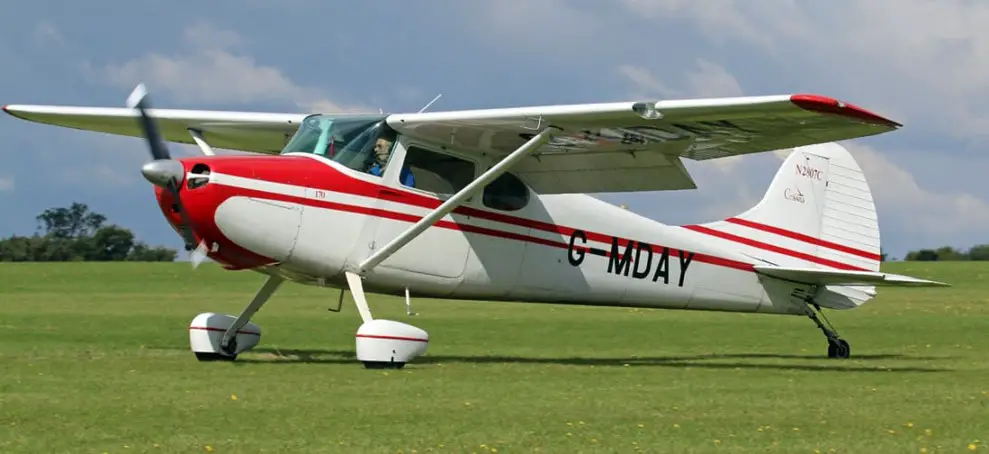
Introduced in 1948, the Cessna 170 arrived at a fascinating crossroads. The postwar aviation boom was in full swing, and pilots were transitioning from military taildraggers to new civilian models. Cessna’s own Model 140 was a successful two-seat trainer, but the market demanded more capability. The 170 was the answer: a four-place, utility-focused aircraft that retained the conventional landing gear of its predecessors.
Production spanned from 1948 to 1956, with three primary variants marking its evolution:
- Model 170 (1948-1949): The original, featuring a flat, “straight” windshield and a 145 horsepower Continental C-145 engine.
- Model 170A (1950-1951): Introduced the iconic “Omni-Vision” rear window and a redesigned, curved windshield that improved visibility and modernized its look.
- Model 170B (1952-1956): The definitive and most-produced version. It incorporated the greatest changes, most notably a redesigned wing with extended, rounded tips (increased span from 36 to 39 feet) for better slow-speed handling and lift. It also featured a redesigned tail and a more refined interior. Most 170Bs were powered by the 145 hp engine, but from 1953 onward, a 165 horsepower Continental O-300-A engine was available as an option.
The 170’s success was undeniable, with over 5,100 aircraft built. Its true legacy, however, is its direct lineage to the most produced airplane in history. In 1956, Cessna made a monumental decision: they added a nosewheel to the 170B airframe, creating the Model 172. The tailwheel era for mass-produced Cessnas was over, but the 170’s DNA lived on, cementing its place as the proud, traditional predecessor to a global icon.
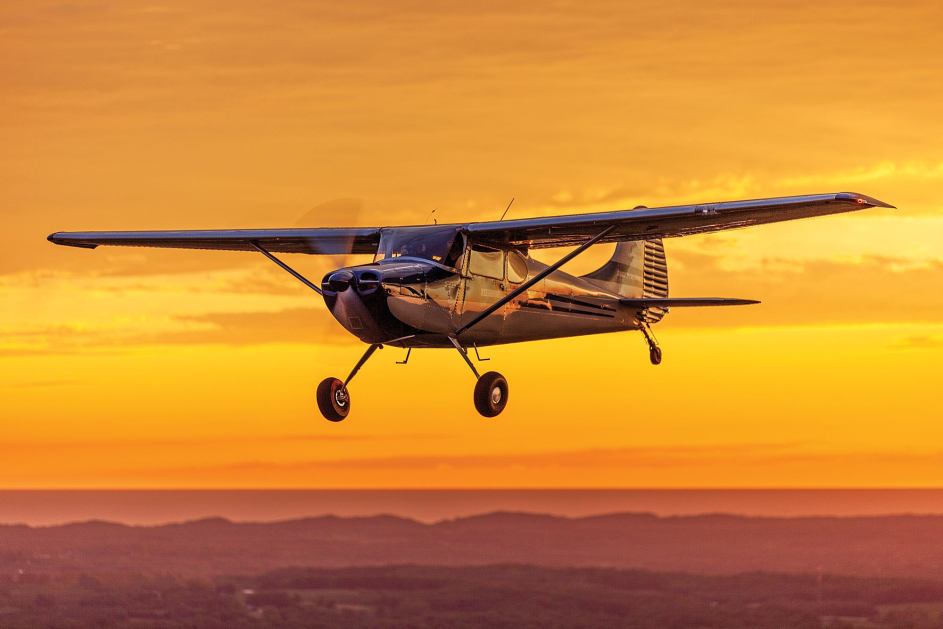
Cessna 170 Specifications
The Cessna 170’s specs reflect its design purpose: a sturdy, honest, and capable four-seat aircraft for the practical pilot.
- Engine: Continental C-145-2 (145 hp) or O-300-A (165 hp)
- Propeller: Fixed Pitch, 2 blade
- Seating: 4
- Length: 25 feet (7.6 meters)
- Wingspan: 36 feet (Model 170/170A), 39 feet (Model 170B) (11 meters)
- Height: 6 feet 7 inches (2 meters)
- Empty Weight: Approximately 1,200 pounds (544 kg)
- Max Takeoff Weight: 2,200 pounds (998 kg)
- Useful Load: Approximately 1,000 pounds (454 kg)
- Fuel Capacity: 42 gallons (40 usable)
Performance Figures:
- Cruise Speed: 105-115 knots (120-132 mph)
- Stall Speed: 45 knots (52 mph)
- Rate of Climb: 670 feet per minute (with 145 hp)
- Service Ceiling: 15,500 feet
- Range: 450-500 nautical miles (520-575 miles)
- Takeoff/Landing Distance: Roughly 600-800 feet over a 50-foot obstacle, highly dependent on pilot technique and surface.
The generous useful load is a hallmark. With full fuel (240 lbs), the aircraft can still carry 760 pounds of people and baggage, making true four-place flights a realistic possibility with careful planning, unlike many of its modern counterparts.
What It Is Like to Fly a Cessna 170
Flying a 170 is an engaging, full-body experience that demands and rewards attention. It is the antithesis of automated, passive flying.
- Preflight and Taxi: The adventure begins on the ground. The tailwheel configuration means the aircraft sits nose-high. During taxi, forward visibility is partially blocked by the engine cowling, requiring gentle “S-turns” to see ahead, a fundamental tailwheel skill. The controls feel directly connected and alive.
- Takeoff: Takeoff in a 170 is an active maneuver. With application of power, you apply right rudder to counteract engine torque. As speed builds, you ease forward on the yoke to lift the tail to a level attitude, improving visibility. The aircraft accelerates in this “tail-low” position until it flies itself off the runway. It’s a dynamic process that teaches precise control coordination.
- In Flight: Once airborne, the 170 reveals its gentle nature. The controls are harmonized and responsive. The large, barn-door flaps provide remarkable lift at low speeds. The cockpit, especially in the 170A and B models with their wraparound windows, offers spectacular visibility. The sound of the continental engine is a steady, reassuring thrum. It flies like a slightly heavier, more solid version of its predecessor, the 140, with a satisfying sense of stability and authority.
- Approach and Landing: This is where the tailwheel pilot earns their keep. The approach is often flown at a slightly higher speed and steeper angle than in a nosewheel aircraft. The roundout and flare are critical. The goal is a smooth, “three-point” touchdown with the main wheels and tailwheel contacting the ground simultaneously, or a “wheel landing” where the mains touch first with the tail still high. Both require practice, finesse, and continuous rudder input to maintain directional control, the famous “dance on the pedals.” Mastering a crosswind landing in a 170 is one of aviation’s most satisfying achievements.

Owning a Cessna 170
Owning a 170 is to become a curator of a living classic. It offers a visceral flying experience and a strong community, but it comes with specific demands.
Purchase Price:
The market for Cessna 170s is strong. A flying, airworthy model in good mechanical condition typically ranges from $40,000 to $70,000. Exceptional, recently restored 170Bs with upgraded avionics and engines can command $80,000 to $100,000. The 170B is generally the most sought-after and valuable variant.
Ongoing Operating Costs (Annual Estimate):
- Hangar: Highly recommended to protect the fabric-covered control surfaces and paint. $2,400 – $5,000/year.
- Insurance: For a pilot with a tailwheel endorsement, annual liability and hull insurance (agreed value) can range from $1,200 to $2,500.
- Annual Inspection: $1,000 – $2,000, depending on what issues are discovered.
- Fuel: Burns 6-8 gallons per hour of avgas. A 50-hour flying year might cost $1,800 – $2,500.
- Engine Reserve: Setting aside $1,500 – $2,500 annually for the eventual engine overhaul is prudent.
Total Estimated Annual Fixed Cost: $6,000 – $12,000+.
Key Considerations for Owners:
- Tailwheel Proficiency: This is non-negotiable. Ownership requires a tailwheel endorsement and a commitment to regular flying to stay proficient. Recurrent training with a qualified instructor is wise.
- Maintenance Knowledge: Understanding the aircraft’s systems, particularly its fabric-covered ailerons, elevators, and rudder, is important. Building a relationship with an A&P mechanic who appreciates classics is key.
- Community: The International Cessna 170 Association is an invaluable resource for technical support, parts sourcing, manuals, and camaraderie through fly-ins.
- Modifications: A huge array of STC (Supplemental Type Certificate) modifications exist, from upgraded engines and alternators to extended baggage compartments and speed modifications. These can enhance utility and value.
Frequently Asked Questions (FAQs) About the Cessna 170
Q1: What is the main difference between a Cessna 170 and a 172?
A: The most fundamental difference is the landing gear. The 170 is a conventional “taildragger,” while the 172 has tricycle “nosewheel” gear. This makes the 172 easier to handle on the ground, especially for novice pilots. The 170 airframe is also slightly lighter and simpler in its early versions.
Q2: Is a Cessna 170 a good first airplane for a new private pilot?
A: It can be, but with major caveats. The pilot must obtain a tailwheel endorsement, which adds complexity. The 170 is honest and forgiving in the air, but its ground handling demands respect, constant attention, and ongoing practice. A new pilot should be committed to dedicated tailwheel training.
Q3: Can a Cessna 170 realistically carry four people?
A: Yes, but within strict limits. With full fuel, the remaining useful load for people and baggage is about 760 lbs. This could accommodate four 160 lb adults with no baggage, or more commonly, two adults, two children, and some baggage. Careful weight and balance calculation is essential for every flight.
Q4: Is the Cessna 170 a good bush plane?
A: Absolutely. It is a legendary bush plane. Its short takeoff and landing (STOL) capabilities, robust landing gear, high-lift wing, and excellent useful load make it ideal for unimproved airstrips. Many 170s are equipped with oversized “tundra” tires, wheel fairings, and other bush modifications.
Q5: What should I look for when buying a used Cessna 170?
A: Prioritize a thorough pre-purchase inspection by a mechanic familiar with the type. Key areas include: corrosion in the steel tube fuselage, condition of the fabric on flight controls, engine health and time since overhaul, spar condition, and documentation of Airworthiness Directive (AD) compliance.


 Aviator Tells
Leave a comment