
It’s a visual command: “fly left” or “fly right.” Whether tracking a highway in the sky defined by a ground-based VOR or executing a precision approach guided by satellite GPS, the CDI is the pilot’s primary visual reference for lateral navigation.
It is the critical bridge between the complex technology of radio navigation and the human need for simple, intuitive guidance, making it one of the most enduring and vital instruments in aviation history.
What is a Course Deviation Indicator (CDI)?
A Course Deviation Indicator (CDI) is a cockpit instrument that displays an aircraft’s lateral position relative to a selected navigation course. It provides immediate, intuitive guidance to help a pilot maintain their intended flight path.
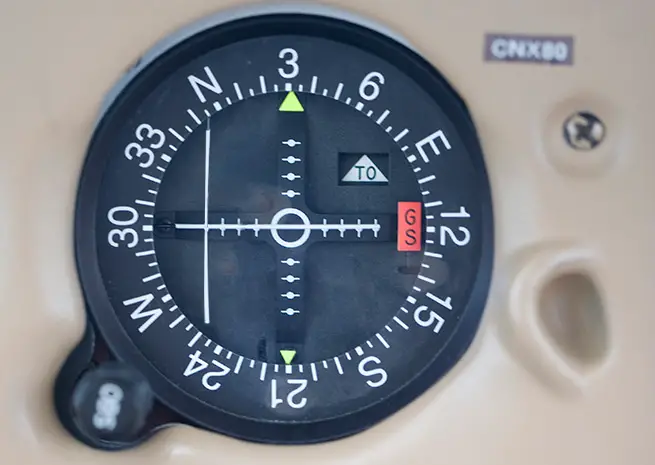
The classic CDI features a vertical needle that moves left or right over a scale of dots. When the needle is centered, the aircraft is perfectly on course. If the needle deflects to the left, the pilot must fly left to regain the centerline, and vice-versa. Despite the advanced glass cockpits of today, the fundamental presentation of CDI information remains unchanged, a testament to its perfect, user-friendly design.
Start your Airbus A320 Type Rating with this book “click here“
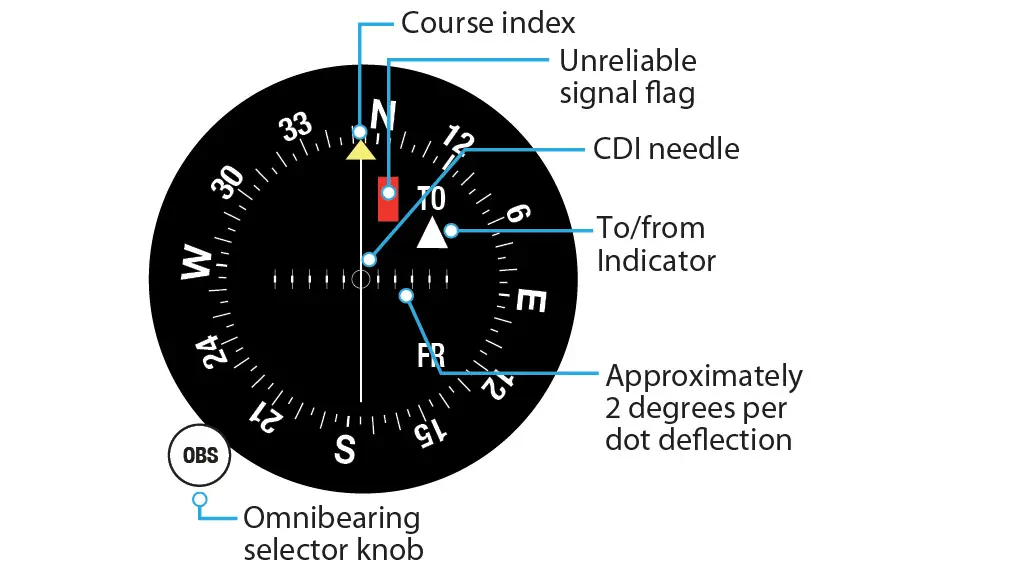
CDI Parts
Understanding the components of a traditional CDI is key to understanding its function:
- The Needle (Deviation Bar): This is the moving vertical needle that is the heart of the display. Its left/right movement directly commands the pilot’s steering inputs.
- The Deviation Scale: A series of dots beneath the needle. Each dot typically represents 2 degrees of deviation from the course centerline. When the needle is fully deflected to either side (covering the last dot), it indicates the aircraft has reached the full-scale deflection limit, which varies depending on the navigation source being used.
- The Omni Bearing Selector (OBS): This is a crucial pilot-controlled knob surrounding the instrument. The pilot uses the OBS to “dial in” the desired course, which is displayed numerically on the instrument. read about it
- The TO/FROM Indicator: This is perhaps the most critical element for situational awareness. It tells the pilot whether flying the selected course will take the aircraft toward (TO) the navigation station or away from (FROM) it. Misinterpreting the TO/FROM indicator is a classic and potentially dangerous pilot error.
The CDI in Action
The CDI itself is a display; its behavior is entirely dependent on the navigation source it is receiving data from. This is where the story of the CDI splits into two key chapters.
1. The Analog Classic: VOR Navigation
When tuned to a VOR (VHF Omnidirectional Range) station, the CDI becomes the visual representation of a “radial.”
- How it Works: The pilot uses the OBS to select a specific magnetic bearing from the VOR station. This is the desired course, or radial.
- The Display: The CDI needle shows the aircraft’s position relative to that chosen radial. If the needle is centered, the aircraft is precisely on that radial.
- Full-Scale Deflection: For a VOR, full-scale needle deflection (covering the last dot) indicates the aircraft is 10 degrees or more off course. At a distance of 60 nautical miles from the station, this translates to being about 10 miles off track.
2. The Digital Modern: GPS Navigation
When driven by a GPS (Global Positioning System), the CDI’s function is similar, but its intelligence is far greater.
- How it Works: The pilot’s Flight Management System or GPS navigator is programmed with a flight plan consisting of a sequence of waypoints. The CDI automatically displays the aircraft’s position relative to the desired “course” between these active waypoints.
- The Display: The needle movement is identical to the VOR display: center for on course, left for fly left.
- The “Scaling” Revolution: This is the critical difference. A GPS-driven CDI is “smart.” Its full-scale deflection value, known as scaling, changes automatically based on the phase of flight.
- En-route: The CDI might be scaled to 5 nautical miles. This means a full needle deflection indicates the aircraft is 5 NM off course. The needle remains sensitive but less “twitchy” over long distances.
- Approach: When the pilot activates an instrument approach procedure, the GPS automatically changes the CDI scaling to 1 nautical mile, and finally to 0.3 NM for the most precise final approach segment. This provides the high sensitivity and precision required for a safe landing in poor visibility.
This ability to scale is what makes GPS navigation so much more precise and intuitive than traditional VOR navigation.
Why the CDI is Non-Negotiable for Pilots
- Universal Language: The “center the needle” concept is a universal language of flight that applies to nearly every form of lateral navigation, from a simple VOR to a complex RNP approach.
- Workload Reduction: It synthesizes complex radio or satellite signals into a single, unambiguous command, drastically reducing pilot cognitive load, especially during high-stress phases like instrument approaches.
- Fundamental Skill: The ability to interpret and promptly respond to CDI indications is a fundamental skill tested on every instrument pilot checkride. It represents core airmanship.
- Critical Redundancy: Even in aircraft with fully automated flight management systems, pilots continuously monitor the CDI as a primary cross-check to ensure the automation is performing as expected.
CDI vs HSI
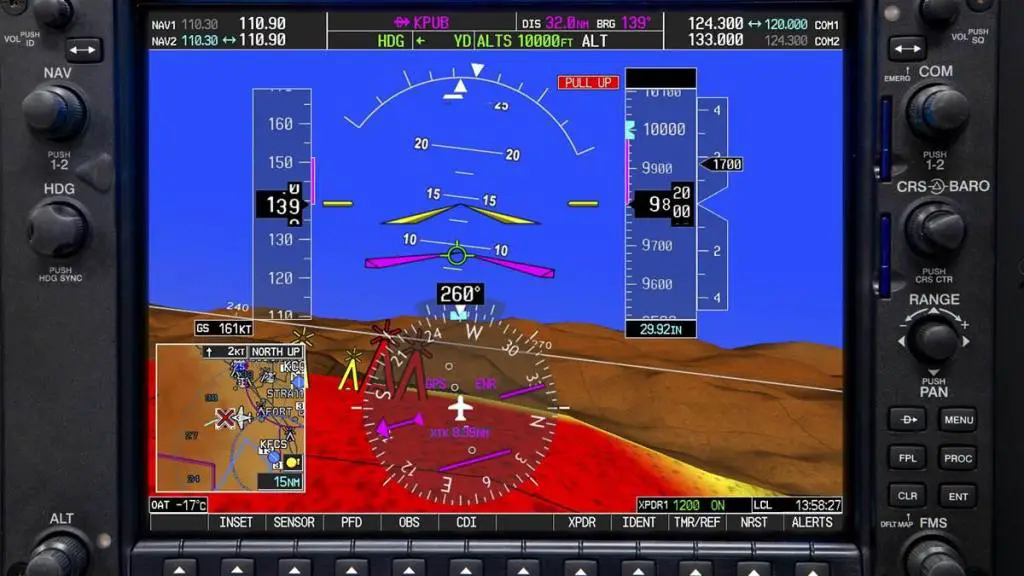
While the CDI is a foundational instrument, many aircraft are equipped with its more advanced cousin, the Horizontal Situation Indicator (HSI).
- CDI: A fixed instrument. The aircraft symbol is stationary in the center, and the course card and needle move around it. The pilot must mentally superimpose the CDI information onto their actual heading.
- HSI: A dynamic, pictographic display. It combines a heading indicator with a CDI. The aircraft symbol is fixed, but the compass card rotates underneath it to show current heading. The CDI needle is superimposed on this moving compass card, creating a intuitive “map-like” view. The HSI instantly shows the relationship between the aircraft’s heading and the desired course, eliminating the mental calculation required with a standard CDI.
Think of it this way: A CDI tells you where the road is. An HSI shows you where the road is in relation to the direction you’re facing.
CDI FAQs
1. What does it mean if the CDI needle is fully deflected?
It means the aircraft has exceeded the maximum deviation for the current scale. With a VOR, this is always ~10 degrees off course. With a GPS, it depends on the phase of flight (e.g., 5 NM off in en-route, 0.3 NM off on an approach). The pilot must turn sharply toward the needle to begin recapturing the course.
2. Why is the TO/FROM indicator so important?
Flying a course with a “FROM” indication when you expect a “TO” indication (or vice-versa) means you are flying directly away from your intended destination. This is a serious navigational error. The TO/FROM flag provides an immediate and critical check of your situational awareness.
3. Can a CDI fail?
Yes. The instrument itself can fail, or, more commonly, the navigation signal it relies on (VOR or GPS) can be lost or unreliable. Pilots are trained to identify failures and switch to backup forms of navigation.
4. What is “CDI scaling” on a GPS?
This is the distance value represented by a full-scale needle deflection. It is the GPS’s way of making the needle appropriately sensitive for the task at hand—less sensitive for en-route flight, and highly sensitive for precision approaches.
5. Is a CDI used for landing?
Absolutely. During an Instrument Landing System (ILS) approach, the CDI needle displays signals from the ILS localizer, providing left/right guidance to align with the runway centerline. For a GPS approach, it displays lateral guidance all the way to the runway.
6. How do pilots practice using a CDI?
Pilots spend countless hours in flight simulators and during actual training flights practicing “tracking” VOR radials and GPS courses, deliberately letting the needle drift and then making smooth corrections to re-center it. This builds the muscle memory and scan pattern required for proficient instrument flight.


 Aviator Tells
Leave a comment