
Thirty seconds. That’s approximately how long it takes for a modern airliner to become unflyable when its navigation systems fail simultaneously. Yet every day, thousands of aircraft navigate safely through thunderstorms, across oceans, and over polar regions with near-perfect precision.
This remarkable safety record depends on a technological marvel most passengers will never see or understand, the Air Data Inertial Reference System (ADIRS). This silent sentinel works relentlessly in the background, translating subtle atmospheric changes and imperceptible movements into the digital language of flight.
When Qantas Flight 72 suddenly pitched downward not once but twice at 37,000 feet, it was this very system that both created the crisis and ultimately helped resolve it, a perfect illustration of how our most advanced protections sometimes contain the seeds of their own failure, and why redundancy remains aviation’s golden rule.
What is ADIRS
The Air Data Inritial Reference System (ADIRS) is an integrated avionics system that combines multiple sensors to provide essential flight data. It serves as the primary source of information for pilots, flight computers, and other aircraft systems about the aircraft’s position, movement, and atmospheric conditions. This system has become the cornerstone of modern glass cockpits, replacing dozens of individual instruments with a unified digital solution.
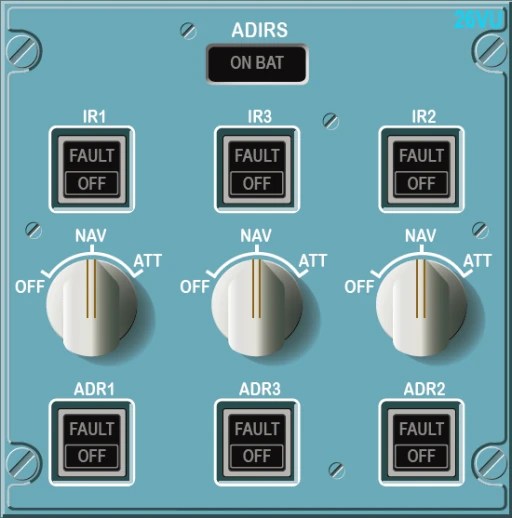
ADIRS consists of three main components:
- Air Data Reference (ADR): Calculates flight parameters using atmospheric pressure
- Inertial Reference (IR): Tracks aircraft position and movement using gyroscopes and accelerometers
- Mode Selector Unit (MSU): Allows pilots to control system functions
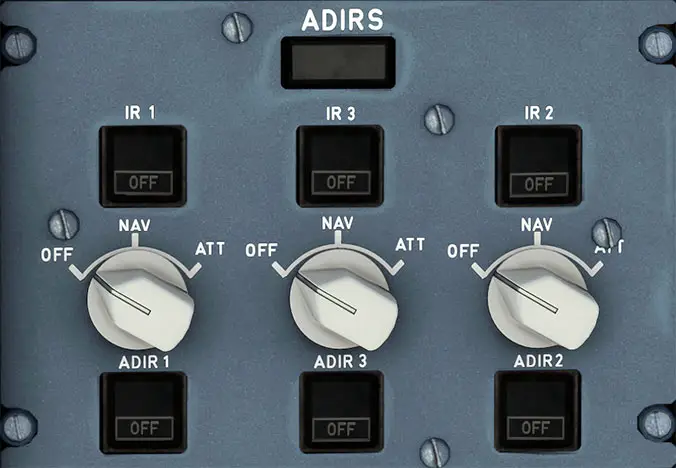
The system typically includes three identical Air Data Inertial Reference Units (ADIRUs) for redundancy, ensuring that a failure in one unit doesn’t compromise flight safety.
The Evolution from Simple Instruments to Integrated Systems
Aviation navigation has undergone a revolutionary transformation:
Mechanical Era (Pre-1970s)
- Pilots relied on individual analog instruments
- Each parameter required a separate gauge
- High workload with constant cross-referencing
- Significant margin for human error
Early Digital Systems (1970s-1990s)
- Introduction of initial inertial reference systems
- Limited integration between systems
- Reduced but still substantial pilot workload
Modern ADIRS (2000s-Present)
- Fully integrated air and inertial data
- Digital outputs to multiple aircraft systems
- Automated monitoring and alerting
- Significant reduction in pilot workload
you’ll need this book before you start your Airbus A320 Type Rating “click here“
How ADIRS Works
Air Data Reference System
The ADR portion of the system uses several external sensors to measure atmospheric conditions:
- Pitot Tubes: Measure dynamic pressure (ram air pressure) to calculate airspeed
- Static Ports: Measure static atmospheric pressure to determine altitude
- Temperature Probes: Measure outside air temperature for various calculations
These measurements allow the ADR to compute:
- Barometric altitude
- Vertical speed
- Indicated airspeed
- Mach number
- Angle of attack
Inertial Reference System
The IR component uses advanced motion sensors to track aircraft movement:
- Ring Laser Gyroscopes: Detect rotational movement in three axes (pitch, roll, yaw)
- Accelerometers: Measure linear acceleration in three dimensions
- GPS Integration: Provides periodic position updates to correct inertial drift
Through complex calculations, the IR can determine:
- Aircraft attitude (pitch, roll, and yaw)
- Heading and track
- Ground speed and velocity
- Current position (latitude and longitude)
Data Integration and Output
The true power of ADIRS lies in its ability to fuse these different data sources into a coherent picture of the aircraft’s state. This integrated information feeds into:
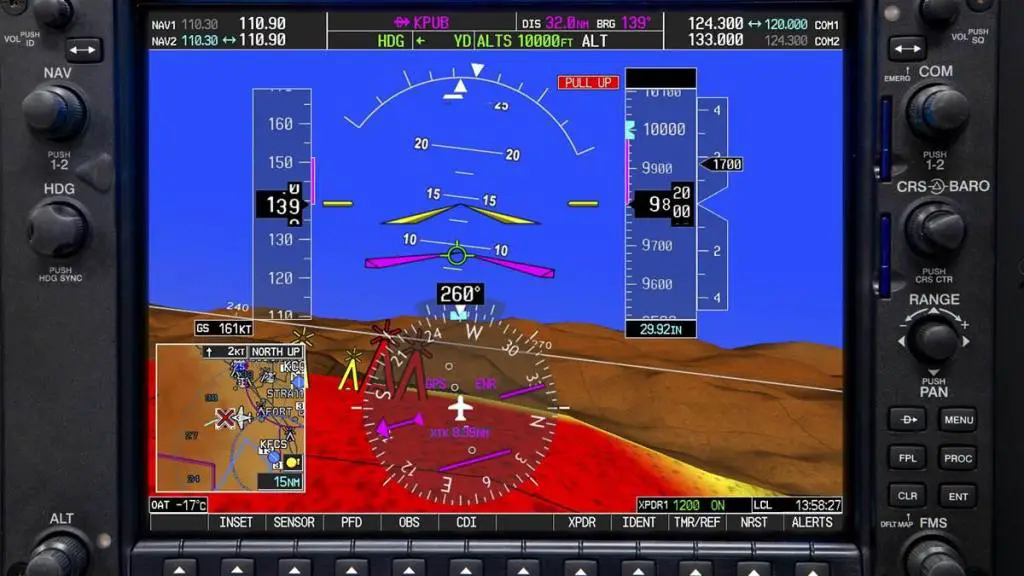
- Primary Flight Displays: Showing attitude, airspeed, altitude, and heading (PFD)
- Navigation Displays: Presenting position and movement data (ND)
- Flight Management Systems: Supporting navigation and guidance (FMS)
- Autopilot and Flight Directors: Enabling automated control
- Warning Systems: Providing alerts for abnormal conditions
Why ADIRS Revolutionized Aviation Safety
Enhanced Situational Awareness
By integrating multiple data sources into a unified system, ADIRS gives pilots a comprehensive understanding of their aircraft’s state. This proves particularly valuable during instrument meteorological conditions when external visual references are unavailable.
Reduced Pilot Workload
Early aviation required pilots to constantly scan and cross-reference numerous separate instruments. ADIRS automates this process, presenting synthesized information that allows crews to focus on decision-making rather than data gathering.
Improved Reliability Through Redundancy
The triple-redundant design of most ADIRS installations means that a failure in one component doesn’t compromise safety. If one ADIRU fails, pilots can switch to another without losing critical information.
Resistance to External Interference
Unlike ground-based navigation systems, inertial reference systems aren’t susceptible to external signal interference or jamming. This makes ADIRS particularly valuable in areas where GPS spoofing or other electronic warfare tactics might be employed.
ADIRS in Emergency Situations
The critical importance of ADIRS becomes most apparent during abnormal operations:
Malaysia Airlines Flight 124 (2005)
An ADIRU fault caused uncommanded maneuvers in a Boeing 777. The system’s design allowed pilots to identify and isolate the faulty unit, preventing a potential catastrophe.
Qantas Flight 72 (2008)
As mentioned earlier, a malfunction in the Number 1 ADIRU caused sudden pitch-down maneuvers. Despite this failure, the redundant design allowed the crew to maintain control and land safely.
Air France Flight 447 (2009)
While multiple factors contributed to this accident, inconsistent air data readings highlighted the importance of reliable ADIRS information and proper pilot response to system failures.
These incidents have led to continuous improvements in ADIRS technology and procedures, making modern systems increasingly robust and reliable.
The Future of ADIRS Technology
Aviation technology never stands still, and ADIRS continues to evolve:
Enhanced Cybersecurity
As aircraft become more connected, protecting navigation systems from cyber threats becomes increasingly important. Next-generation ADIRS incorporates advanced encryption and security protocols to prevent unauthorized access or spoofing.
Improved Integration
Future systems will seamlessly blend data from more sources, including space-based navigation, enhanced vision systems, and even other aircraft via datalink networks.
Artificial Intelligence and Predictive Capabilities
AI algorithms may soon help ADIRS predict potential failures before they occur, allowing for preventative maintenance and even greater system reliability.
Miniaturization and Efficiency
Ongoing developments in microelectromechanical systems (MEMS) technology will make future ADIRS units smaller, lighter, and more energy-efficient while maintaining or improving performance.
ADIRS FAQs
How many ADIRUs does a typical aircraft have?
Most commercial aircraft feature three ADIRUs for redundancy. This allows the aircraft to continue operating safely even if one or sometimes two units fail.
Can ADIRS work without GPS?
Yes. The inertial reference portion of ADIRS is self-contained and doesn’t require external signals like GPS. However, GPS updates help correct small positional errors that accumulate over time in inertial systems.
What happens during ADIRS alignment?
Before flight, ADIRS must undergo an alignment process where it establishes its initial position and orientation. This typically takes several minutes while the aircraft is stationary and involves precisely measuring the Earth’s rotation to determine true north.
How often does ADIRS require maintenance?
ADIRS components undergo regular maintenance checks according to manufacturer recommendations and aviation authority requirements. Modern systems include built-in test equipment that helps technicians quickly identify and address issues.
Why do aircraft still have traditional instruments if they have ADIRS?
Regulators require backup instruments in case of complete ADIRS failure. These traditional gauges provide essential information using separate sensors and displays, ensuring pilots can still fly the aircraft even with total ADIRS failure.
Can ADIRS be affected by weather?
While extreme weather can potentially affect the air data sensors (pitot tubes may ice over), the systems include protections like heating elements to prevent this. The inertial reference portion is completely unaffected by weather conditions.
How accurate is ADIRS?
Modern ADIRS is extremely accurate. The inertial position typically drifts by less than 1 nautical mile per hour of flight, and this error is periodically corrected using GPS updates.


 Aviator Tells
Leave a comment