
Picture a military commander overseeing a complex operation. Instead of juggling paper maps, weather reports, and comms devices, they watch a single screen synthesizing live intelligence—enemy positions, terrain hazards, and team status.
In today’s cockpit, pilots have an equally powerful tool: the Multifunction Display (MFD). This digital nerve center transforms raw data into actionable insight, turning turbulence, traffic, and technical threats into manageable challenges. Here’s why this unsung hero is aviation’s ultimate force multiplier.
What is an MFD
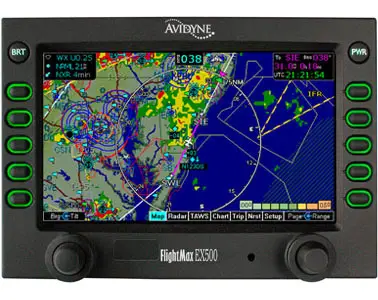
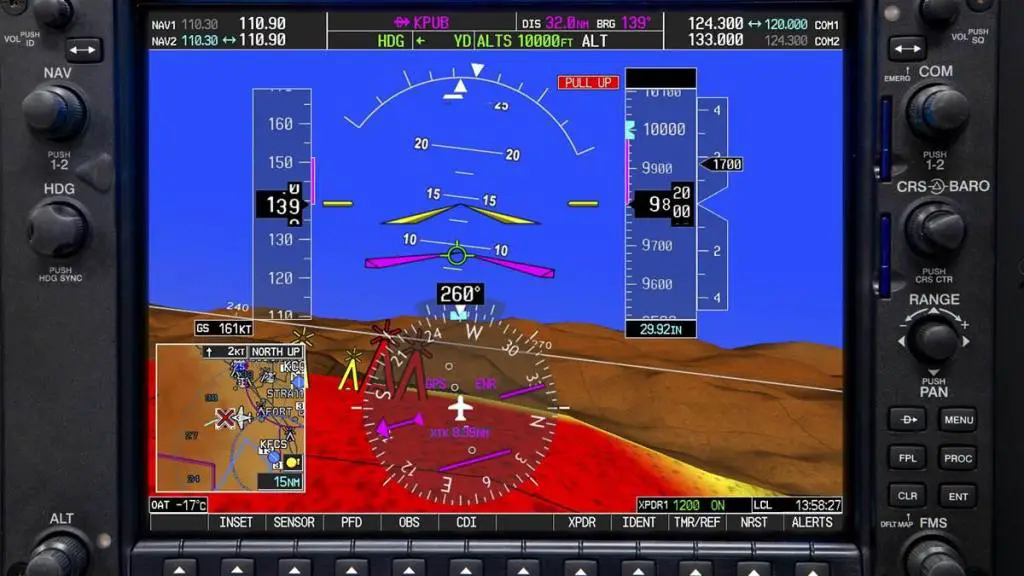
The Multifunction Display (MFD) is the cockpit’s mission control screen—a dynamic digital interface that consolidates navigation, surveillance, and aircraft system data. Unlike fixed analog gauges, it adapts to pilot needs, toggling between:
- Real-time weather radar
- Moving maps with airspace boundaries
- Engine health diagnostics
- Terrain and traffic collision alerts
- Electrical/hydraulic system schematics
Think of it as the cockpit’s “Swiss Army knife”: versatile, indispensable, and always context-aware.
MFDs vs. Legacy Systems
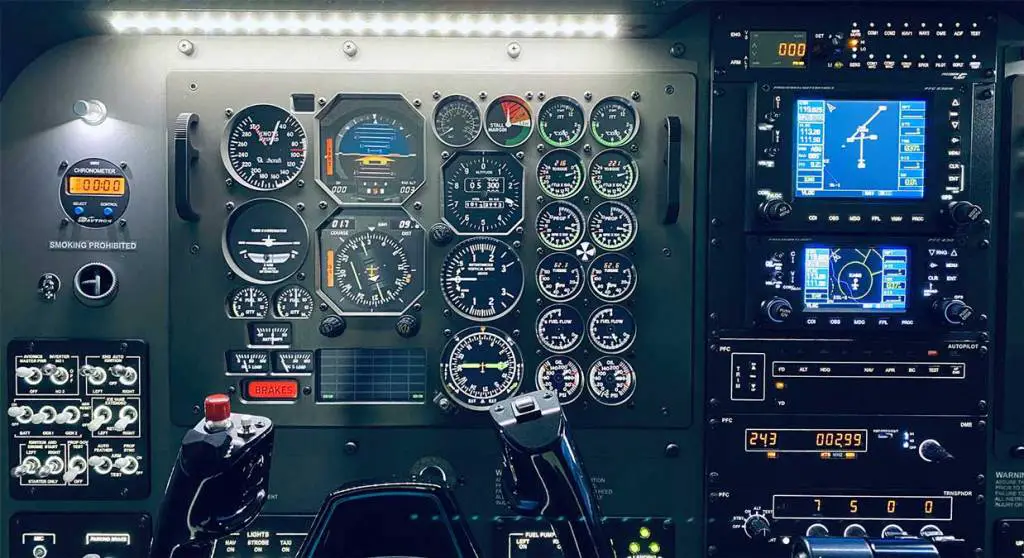
The Analog Era (Pre-1990s)
Pilots faced “panel sprawl”:
- 40+ dedicated gauges
- Paper charts cluttering the flight deck
- No integrated weather or terrain awareness
The Digital Shift (1990s-Today)
- 1990s: First-gen CRT MFDs replaced basic maps
- 2000s: LCD screens added terrain/traffic overlays
- 2020s: Touchscreens with AI-driven insights
MFD Impact at a Glance
| Challenge | Legacy Cockpit | MFD Solution |
|---|---|---|
| Navigation | Manual chart cross-checks | GPS-driven moving maps |
| Weather Hazards | Reactive avoidance | Storm cell tracking 200nm ahead |
| Systems Failure | Gauges + troubleshooting | Automated checklists |
| Weight Penalty | 80+ lbs of instruments | 8-15 lbs per screen |
Multi Functional Display Capabilities
1. The Navigator
Displays aircraft position over geo-referenced charts with:
- Flight plan routing
- Restricted airspace alerts
- Airport diagrams (runways, taxiways)
Pilot Tip: Overlay approach plates for seamless transitions.
2. The Weather Sentinel
Fuses onboard radar with satellite data to show:
- Storm intensity (red/yellow/green)
- Turbulence zones
- Icing potential
Critical for rerouting around convective cells.
3. The Traffic Controller
Integrates ADS-B/TCAS to display:
- Nearby aircraft (direction, altitude)
- Resolution advisories (“CLIMB!”)
- Airfield traffic patterns
4. The Systems Engineer
Monitors aircraft health via synoptic pages:
- Engine parameters: EGT, fuel flow, RPM
- Electrical: Battery voltage, bus loads
- Environmental: Cabin altitude, O₂ levels
Color thresholds flag anomalies instantly.
5. The Backup Commander
If the Primary Flight Display (PFD) fails, the MFD can revert to show:
- Artificial horizon
- Critical flight data
- Essential navigation
you’ll need this book before you start your Airbus A320 Type Rating “click here“
Where You’ll Find MFDs
| Aircraft Type | MFD Examples | Key Features |
|---|---|---|
| Commercial Jets | Boeing 787, Airbus A350 | 15″ touchscreens, 4D weather |
| Business Aviation | Gulfstream G700, Bombardier Global | Synthetic Vision, wireless map |
| General Aviation | Cirrus SR22T, Piper M600 | Garmin G3000, split-screen |
| Military | F-35, CH-47 Chinook | Video feeds, weapon targeting |
Why MFDs Are Non-Negotiable for Modern Pilots
- Decision Velocity: Reduces “head-down time” by 70% during emergencies.
- Fuel Efficiency: Optimal routing saves 5-12% on long hauls.
- Error Prevention: Database-driven approaches prevent runway confusion.
- Training Efficiency: Simulators replicate MFD failures realistically.
- Space Optimization: Replaces 18+ gauges in a Cessna 172.
Navigating Limitations
- Database Discipline: Navigation updates required every 28 days (Jeppesen/FAA).
- Skill Preservation: Regulators mandate “manual flying” hours to prevent over-reliance.
- Failure Protocols: Dual-screen redundancy + analog backups are critical.
The Next Frontier: AI, AR, and Predictive MFDs
- Augmented Reality: Runway outlines projected onto head-up displays (HUDs).
- Machine Learning: Predicting engine faults 50+ flight hours early.
- Voice Integration: “Show traffic westbound below 10,000 feet.”
MFD FAQs: What Pilots Actually Ask
1. Can I fly without an MFD?
Yes, but it’s like sailing without radar—possible but needlessly risky in complex airspace.
2. Why do military MFDs look different?
Ruggedized against EMP/vibration, with encrypted data links and weapons integration.
3. How long do MFD screens last?
~15,000 flight hours (5-7 years) before LCD degradation.
4. Can I add an MFD to my vintage plane?
Absolutely—Garmin’s G5 costs ~$2,200 and fits most legacy panels.
5. What’s the biggest MFD misconception?
“That it replaces pilot judgment.” It doesn’t—it enhances contextual awareness.
6. Do drones use MFDs?
Ground control stations mirror cockpit MFDs with added payload controls.

 Aviator Tells
Leave a comment