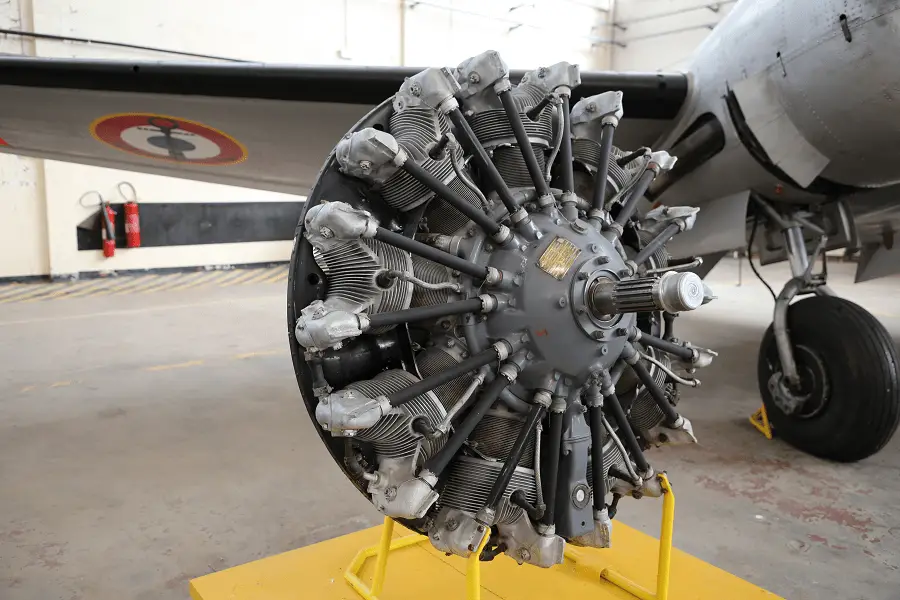
Introduced in 1929, the R-985 arrived on the scene as Pratt & Whitney sought to expand its successful Wasp family to meet a growing market need. Airlines and aircraft manufacturers wanted a reliable, medium-power engine that was lighter and more fuel-efficient than the larger R-1340, yet still offered the radial engine’s signature durability and ease of maintenance.
The Wasp Junior was an instant hit. Its timing was perfect, coinciding with a boom in commercial aviation and the development of new, more sophisticated cabin-class monoplanes. When the United States entered World War II, the R-985 found its ultimate calling. It became the primary trainer engine for the U.S. Navy, powering the North American SNJ Texan (the Navy’s version of the AT-6) and a host of other trainer and utility aircraft. Its reliability was perfect for the punishing routine of flight training.
Post-war, the engine’s career was far from over. It became the powerplant of choice for the revolutionary Beechcraft Model 18 “Twin Beech,” which served as an executive transport, airliner, and navigational trainer for decades. Its simplicity and toughness also made it ideal for the demanding world of agricultural aviation and bush flying. Production ran for over three decades, with nearly 40,000 units built, a testament to its unparalleled utility and longevity.
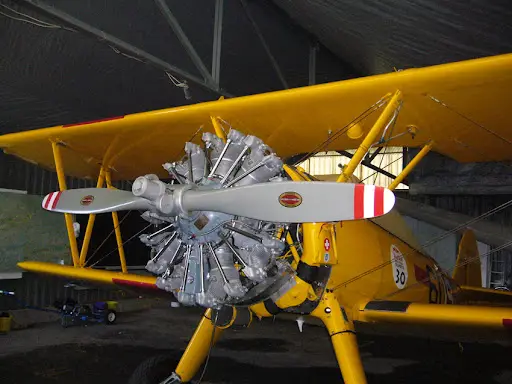
Pratt & Whitney R-985 Specifications
The R-985 shared the same brilliant, air-cooled radial DNA as the larger Wasp but was optimized for a different mission profile: exceptional reliability and efficiency in a compact, manageable package.
Key Specifications:
- Configuration: 9-cylinder, single-row, air-cooled radial
- Displacement: 985 cubic inches (16.1 liters)
- Bore and Stroke: 5.156 in × 5.0 in (131 mm × 127 mm)
- Dry Weight: Approximately 600 to 650 pounds (272-295 kg)
- Compression Ratio: 6.0:1 (typical)
- Supercharger: Single-speed, single-stage, gear-driven centrifugal supercharger
- Fuel System: Updraft carburetor or, in later models, direct fuel injection
- Power Output: Evolved from 300 hp in early models to a robust 450 hp in late-production military variants like the R-985-AN-14B.
Design Hallmarks:
- Compact and Light: The smaller displacement and physical size made it ideal for twin-engine installations (like the Beech 18) and lighter airframes where the bigger R-1340 would be overkill.
- Inherited Toughness: It retained all the robustness of the Wasp design: forged steel cylinders, sodium-cooled exhaust valves, and a rugged crankshaft. It was built to withstand the rigors of student pilots, short-field operations, and low-level agricultural work.
- Supercharger Efficiency: Its effective supercharger allowed it to maintain good power output at altitude, which was crucial for its role in instrument and navigation trainers that operated in various flight regimes.
- Maintenance Accessibility: Like all classic radials, its design allowed mechanics relatively easy access to cylinders and accessories, supporting operations in remote locations with limited shop facilities.
Operating an R-985
Flying behind a Wasp Junior is a classic, hands-on aviation experience that engages all the senses.
- Startup Sequence: Starting is a deliberate process. After ensuring the propeller area is clear, the pilot engages the starter (electric or inertia). The engine turns over with a mechanical groan until the first cylinder fires, followed by a rapid succession of sharp pops as the remaining cylinders catch. The engine settles into a lumpy, shaking idle, with the distinct scent of warm oil and fuel filling the cockpit.
- The Signature Sound: The R-985’s sound is sharper and slightly higher-pitched than the deeper rumble of the R-1340. At full power, it produces a smooth, furious roar that is both exhilarating and businesslike. Pilots learn to “read” the engine by its sound and feel.
- Cockpit Management: The pilot actively manages mixture, propeller RPM (if equipped with a constant-speed prop), and carburetor heat. Monitoring cylinder head temperature (CHT) and oil temperature is critical, especially during climb or in hot weather. The engine responds well to careful leaning for cruise efficiency.
- Reliability Personified: The dominant feeling a pilot has with a Wasp Junior is one of confidence. It starts predictably, runs smoothly at its chosen power setting, and delivers its power consistently. This predictable nature is exactly what made it such an outstanding trainer and utility engine.
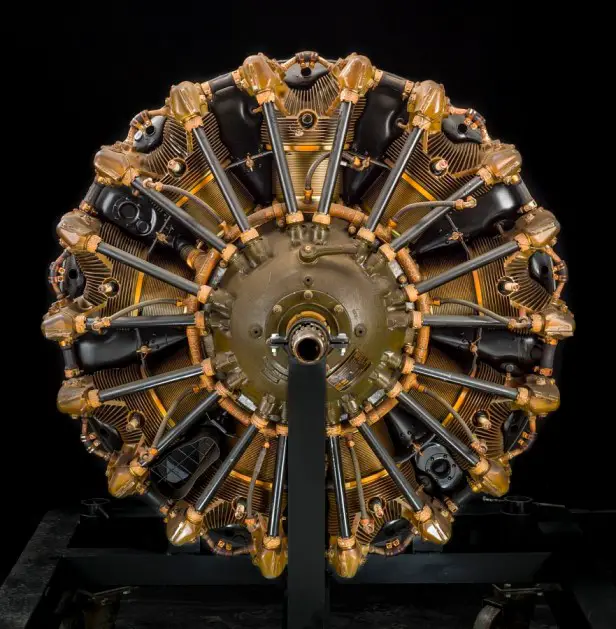
Aircraft Powered by the Wasp Junior
- Beechcraft Model 18 “Twin Beech”: The engine’s most famous partner. The sight and sound of a Twin Beech, with a Wasp Junior on each wing, is iconic. It served in countless roles: corporate shuttle, feeder airliner, WWII multi-engine trainer, and cargo hauler.
- North American T-6/SNJ Texan: While many Texans used the R-1340, a significant number, especially later Navy SNJ variants, were powered by the 450 hp R-985-AN-14B. Its performance was spirited and perfectly suited for advanced training.
- de Havilland Canada DHC-2 Beaver: The radial-powered Beaver, often equipped with the R-985, is the quintessential bush plane. The engine’s high torque and reliability for short takeoffs and landings were instrumental in the Beaver’s legendary STOL performance.
- Grumman G-21A Goose: This amphibious flying boat used two R-985s to provide reliable service to remote coastal communities and corporations.
Pratt & Whitney R-985 Maintenance
Keeping an R-985 airworthy is a commitment to preserving a piece of functional history, undertaken by dedicated warbird restorers, bush pilots, and vintage aircraft enthusiasts.
Practical Considerations for Owners:
- Maintenance Expertise: Requires mechanics with specific radial engine knowledge. Annual or 100-hour inspections are detailed, focusing on cylinder compression, valve health, and mag timing. “Pulling through” the prop by hand before startup is a mandatory ritual to clear any accumulated oil from the lower cylinders.
- Parts and Support: The good news is that, due to the engine’s enormous production run, a robust support network exists. Companies like Covington Aircraft in Oklahoma specialize in R-985 overhaul and parts. The community of owners is an invaluable resource.
- Operating Costs: It runs on 100LL avgas. Oil consumption is a feature, not a bug; a quart per hour is not uncommon. A top overhaul (cylinders, pistons, rings) might cost $25,000-$40,000, while a full factory-level overhaul can approach $80,000 or more.
- Operational Philosophy: Owners operate these engines with a mindset of preservation and respect. They are not typically run at maximum continuous power but are operated within conservative parameters to ensure their longevity for generations to come.
Frequently Asked Questions (FAQs)
Q1: What’s the main difference between the R-985 and the R-1340?
A: The primary difference is size and power. The R-1340 (1340 cu in) is larger, heavier, and was typically rated between 450-600 hp. The R-985 (985 cu in) is more compact, lighter, and was rated between 300-450 hp. The R-985 was often chosen for applications where its lower weight and sufficient power provided a better overall aircraft performance envelope.
Q2: Why was the R-985 so popular on twin-engine aircraft like the Beech 18?
A: Its excellent power-to-weight ratio, proven reliability, and manageable size made it an ideal choice for twins. Two R-985s provided ample power for the airframe while keeping weight and complexity in check, offering a great balance of performance and twin-engine safety for its era.
Q3: Is the “Wasp Junior” still in production?
A: No, production ended decades ago. However, extensive support for overhaul, maintenance, and parts manufacturing continues through specialized shops, keeping the vast existing fleet flying.
Q4: What does the “AN” designation mean in model numbers like R-985-AN-14B?
A: “AN” stands for “Army-Navy.” It indicates the engine was built to a joint U.S. Army and Navy technical specification, standardizing parts and performance for military procurement.

 Aviator Tells
Leave a comment