
Invisible to the naked eye, a silent crisis unfolds as circuit boards risk overheating. This is where the Avionics Equipment Ventilation Computer (AEVC) emerges as aviation’s unsung guardian.
This sophisticated system constantly regulates temperature for critical avionics, ensuring flight computers, navigation systems, and communication equipment operate within safe thermal limits.
What is the Avionics Equipment Ventilation Computer (AEVC)?
The Avionics Equipment Ventilation Computer (AEVC) is the intelligent control unit that manages the temperature of aircraft electronic systems. It automatically selects and maintains one of three ventilation configurations based on external conditions and aircraft status.
This system protects millions of dollars in avionic equipment while ensuring continuous operation of flight-critical systems. Unlike simple cooling systems, the AEVC uses sophisticated sensors and algorithms to predict thermal loads and prevent overheating before it occurs.
you’ll need this book before you start your Airbus A320 Type Rating “click here“
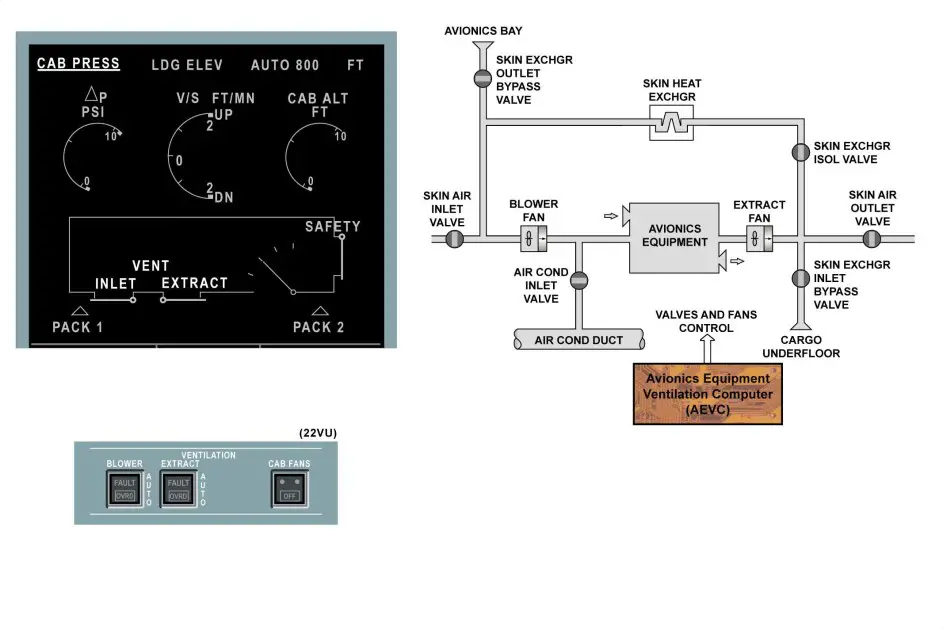
AEVC Configurations
1. Open Circuit Configuration
Used when external conditions permit cooling with ambient air. The system draws outside air through skin valves, circulates it through the avionics bay, and exhausts it overboard. This configuration activates automatically when the aircraft is on ground with skin temperature above approximately 12°C (53.6°F) and increasing, or above 9°C (48.2°F) and decreasing.
2. Closed Circuit Configuration
Engaged when external temperatures are too low or conditions aren’t suitable for open cooling. The system recirculates air through a heat exchanger, maintaining optimal temperatures without introducing external air. This configuration protects avionics from extreme cold while preventing moisture accumulation that could cause short circuits.
3. Partially Open Circuit Configuration
A hybrid mode where the system blends closed-circuit efficiency with limited fresh air exchange. This configuration activates during high thermal load conditions, allowing partial overboard exhaust while maintaining most air in circulation. The system automatically opens a smaller flap within the outlet valve during high-temperature conditions.
Table: AEVC Operational Configurations
| Configuration | When Activated | Key Characteristics |
|---|---|---|
| Open Circuit | Ground operations with favorable temperatures | Uses ambient air, full overboard exhaust |
| Closed Circuit | Low external temperatures or unfavorable conditions | Recirculates air through heat exchanger |
| Partially Open | High thermal load conditions | Hybrid approach with partial exhaust |
AEVC System Components
1. Control Computer
The AEVC itself processes data from multiple sensors and automatically selects the appropriate configuration. It continuously monitors temperature readings, aircraft status (ground/air), and system performance.
2. Ventilation Fans
Dual fan systems provide both blowing and extraction functions. These high-reliability motors ensure constant airflow through the avionics bay regardless of configuration.
3. Temperature Sensors
Multiple sensors strategically placed throughout the avionics bay provide real-time thermal data. The computer uses this information to predict trends and prevent overheating.
4. Valve System
Electrically operated valves control airflow pathways. The system includes skin inlet/outlet valves, heat exchanger isolation valves, and bypass valves that work in concert to direct airflow.
5. Heat Exchanger
The skin heat exchanger transfers heat from avionics bay air to the aircraft’s skin during closed-circuit operation. This efficient method uses the aircraft’s external surface as a radiator.
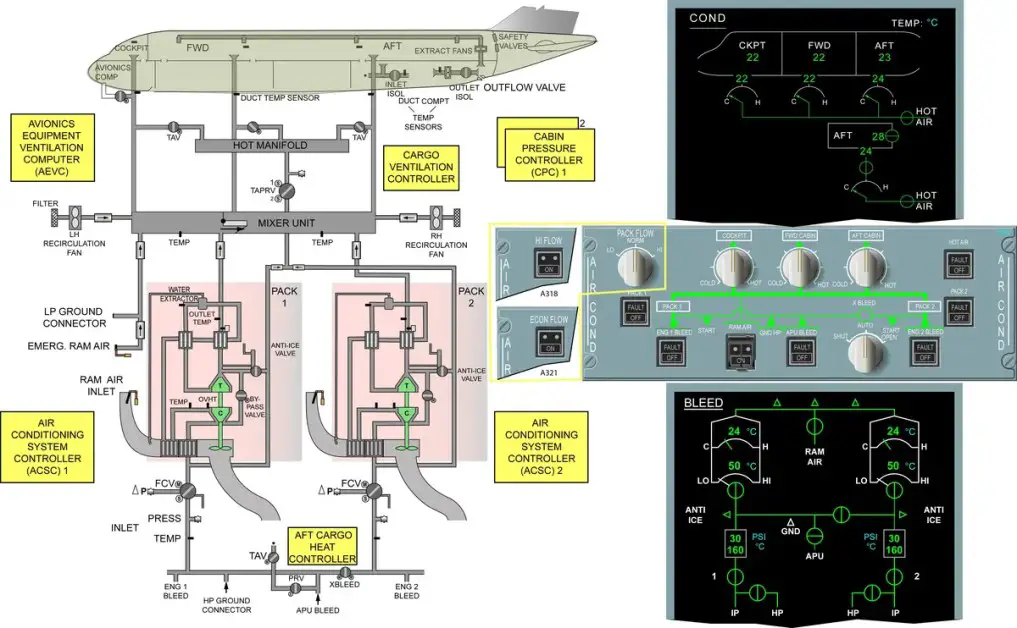
AEVC in Different Flight Phases
Ground Operations
During ground operations, the system typically uses open-circuit configuration when temperatures permit. The AEVC considers factors like engine operation, external temperature, and equipment heat load to optimize cooling.
Takeoff and Climb
As the aircraft accelerates, the system may transition between configurations to accommodate changing airflow conditions and increasing electronic loads.
Cruise Phase
At altitude, the system typically operates in closed-circuit configuration, efficiently managing temperatures while conserving energy.
Descent and Landing
During descent, the system prepares for ground operations, potentially transitioning to open-circuit configuration if conditions permit.
AEVC Maintenance and Troubleshooting
Regular Maintenance Requirements
The AEVC system requires regular inspection of filters, fans, and sensors. Maintenance crews verify proper operation through built-in test equipment and functional checks.
Common Issues
- Filter clogging affecting airflow
- Fan motor wear reducing performance
- Sensor calibration drift causing improper configuration selection
- Valve mechanism sticking limiting configuration changes
System Monitoring
Pilots can monitor AEVC status through cockpit indications, though the system primarily operates automatically without requiring crew intervention.
AEVC FAQs
What happens if the AEVC fails?
Aircraft have redundant systems and procedures for AEVC failures. Pilots can manually select ventilation modes, and the system is designed to fail-safe to ensure avionics remain adequately cooled.
How does the AEVC handle extreme temperatures?
The system automatically selects the appropriate configuration for temperature extremes. In very cold conditions, it maintains closed-circuit operation to prevent freezing, while in extreme heat, it maximizes cooling capacity.
Can the AEVC be overridden by pilots?
While the system operates automatically, pilots can manually select modes if necessary. However, this is rarely required as the computer typically makes optimal choices.
How often does the AEVC change configurations?
The system may change configurations multiple times during a flight as conditions change. Transitions are seamless and designed not to distract the flight crew.
What maintenance does the AEVC require?
Regular maintenance includes filter changes, fan inspections, sensor calibration, and system functional tests. These are typically performed during routine aircraft checks.
How has AEVC technology evolved?
Early systems had manual controls and simpler operation. Modern AEVCs use digital computing, multiple sensors, and predictive algorithms for optimal thermal management.
Does the AEVC cool all avionics equally?
The system maintains overall bay temperature, but some critical components may have additional cooling measures. The AEVC ensures the general environment remains within safe limits.

 Aviator Tells
Leave a comment