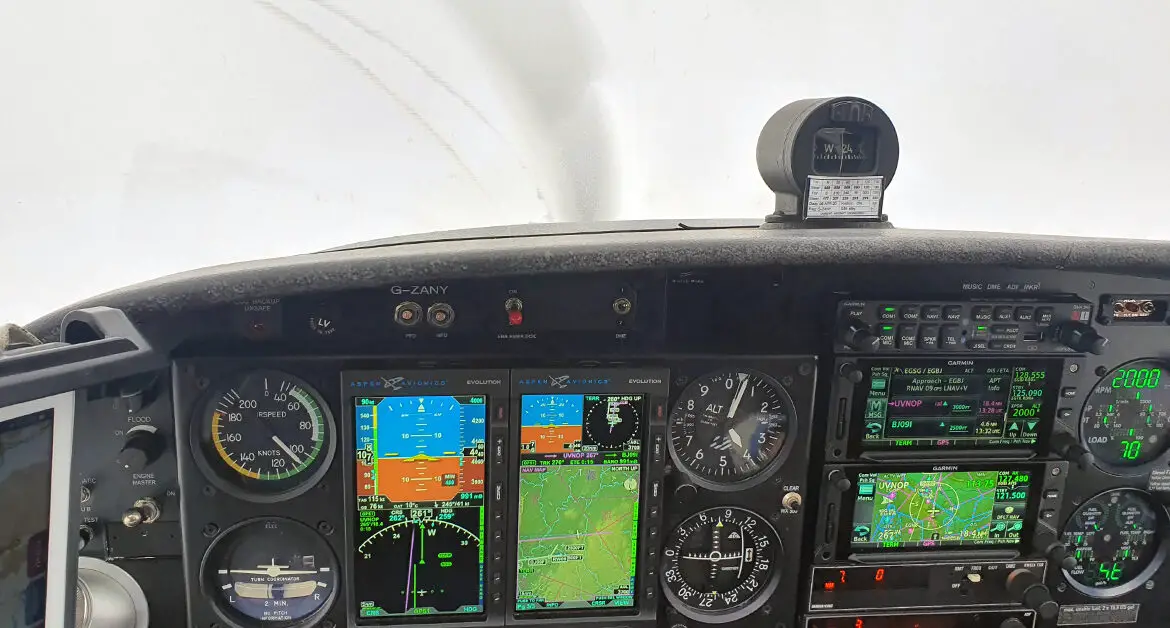
Soaring through a pristine blue sky, navigating by landmarks and the horizon – that’s the dream of visual flight (VFR). But what happens when the clouds descend, the rain lashes the windshield, and the familiar ground vanishes?
This is the domain of IMC – Instrument Meteorological Conditions. It’s not just “bad weather”; it’s a fundamental shift in how pilots operate, demanding specialized skills, equipment, and procedures. Understanding IMC is crucial for appreciating the complexity and safety of modern aviation, whether you’re a pilot, passenger, or enthusiast.
What Exactly is IMC? (More Than Just Bad Weather)
IMC stands for Instrument Meteorological Conditions. It’s formally defined as weather conditions expressed in terms of visibility, distance from cloud, and ceiling, that are below the minimums specified for Visual Meteorological Conditions (VMC).
In simpler terms:
- Visibility is too low to see and avoid other aircraft, terrain, or obstacles visually.
- Clouds are too close (or you’re inside them), obscuring the horizon and ground references.
- The cloud ceiling is too low to fly above it while maintaining VMC cloud clearances below.
The Key Takeaway: When weather deteriorates below VMC minimums, you enter IMC. Flying in IMC means you cannot safely navigate or control the aircraft solely by looking outside. You must rely entirely on the aircraft’s instruments and follow specific rules – Instrument Flight Rules (IFR).

IMC vs. VMC
The distinction between VMC and IMC isn’t just academic; it’s a fundamental safety boundary:
- VMC (Visual Meteorological Conditions): “I can see well enough to fly by looking out the window.” Pilots navigate visually, avoid traffic visually (“see-and-avoid”), and maintain orientation using the horizon and ground. Governed by Visual Flight Rules (VFR).
- IMC (Instrument Meteorological Conditions): “I cannot see well enough to fly visually.” Outside visual references are unreliable or non-existent. Pilots must navigate, control the aircraft, and avoid hazards solely by reference to flight instruments. Governed by Instrument Flight Rules (IFR).
Crossing from VMC into IMC inadvertently is one of the most dangerous situations in aviation, particularly for pilots not trained or equipped for it.
Why we Fly in IMC?
You might wonder, “Why fly in bad weather at all?” The answer lies in the necessity and capability of modern aviation:
- Operational Necessity: Airlines, cargo carriers, medical flights, and many business aircraft operate on tight schedules. Avoiding all IMC would cause massive disruptions. IFR allows predictable operations regardless of clouds or lower visibility (within limits).
- System Efficiency: The structured nature of IFR flying, managed by Air Traffic Control (ATC), allows for the safe and efficient flow of large volumes of aircraft through busy airspace and into major airports, even in poor weather.
- Accessibility: Many airports, especially in regions prone to fog or low clouds, rely on IFR approaches to allow landings when VFR would be impossible. This is critical for commerce and emergency services.
- Overcoming Geography: Flying over large bodies of water, vast deserts, or mountainous regions often involves segments where VMC isn’t guaranteed or visual navigation is impractical. IFR provides a safe path.
The Pillars of Safe IMC Flight: IFR
Flying safely in IMC isn’t about bravery; it’s about rigorous systems, training, and procedures encapsulated in Instrument Flight Rules (IFR). IFR is the framework that makes IMC operations possible. It requires three key elements:
- An Instrument-Rated Pilot:
- Specialized Training: Instrument rating training is intensive, focusing on advanced aerodynamics, instrument interpretation, precision navigation, understanding ATC procedures, and crucially, recovery from unusual attitudes solely by instruments.
- Strict Standards: Pilots must pass demanding written, oral, and practical flight tests.
- Currency Requirements: Instrument-rated pilots must perform specific instrument approaches, holding procedures, and navigation tasks regularly (typically every 6 months) to remain legally current.
- An IFR-Certified Aircraft:
- Required Instruments: Beyond basic flight instruments (Airspeed Indicator, Attitude Indicator, Altimeter, Turn Coordinator, Heading Indicator, Vertical Speed Indicator), IFR aircraft need specific, certified navigation and communication equipment. This typically includes:
- Capable Navigation Systems: VOR, ILS, GPS (often with WAAS for precision approaches), DME, or ADF.
- Redundancy: Often duplicate instruments or systems (like two VORs or a backup attitude indicator).
- Specific Radios: Two-way communication radios capable of communicating with ATC.
- IFR-Certified GPS: Not all GPS units are approved for IFR navigation; they must meet stringent TSO standards.
- Pitot-Static System & Altimeter Certification: Critically accurate for altitude maintenance in clouds.
- Maintenance: Aircraft flown under IFR must adhere to stricter maintenance schedules and inspections.
- Required Instruments: Beyond basic flight instruments (Airspeed Indicator, Attitude Indicator, Altimeter, Turn Coordinator, Heading Indicator, Vertical Speed Indicator), IFR aircraft need specific, certified navigation and communication equipment. This typically includes:
- An IFR Flight Plan and ATC Control:
- Flight Plan: Pilots file a detailed IFR flight plan with ATC before departure. This includes route, altitudes, speeds, fuel, alternates, and more.
- ATC Clearance: Pilots receive an explicit clearance from ATC before entering controlled airspace or IMC. This clearance dictates the exact route, altitude, and any specific instructions.
- Positive Control: Once on an IFR flight plan, ATC provides separation services. Controllers ensure IFR aircraft maintain safe distances vertically, horizontally, and longitudinally from other IFR traffic. They also provide terrain and obstacle clearance guidance along the cleared route.
- Continuous Monitoring: Pilots are in constant communication with ATC, reporting positions, altitudes, and any deviations or issues. ATC provides vectors, altitude changes, and approach clearances.

Why IMC is Dangerous for the Unprepared
While IFR makes IMC flight safe for trained and equipped pilots, it remains extremely hazardous for those who are not:
- Spatial Disorientation (The Silent Killer): This is the primary danger. When visual references are lost, the body’s senses (inner ear, muscle sense) can provide false and compelling information about the aircraft’s attitude and motion. A pilot might feel like they’re straight and level while actually being in a steep, diving turn. Without constant reference to flight instruments, disorientation leads to loss of control within seconds. It can happen to anyone without instrument training.
- Loss of the “See-and-Avoid” Principle: In IMC, pilots cannot visually spot other aircraft, terrain, or obstacles. Without ATC separation (which VFR pilots don’t receive), the risk of collision skyrockets.
- Increased Workload: Flying solely by instruments demands intense concentration and constant cross-checking of multiple gauges. Managing navigation, communication, and aircraft control simultaneously is significantly more demanding than VFR flight.
- Weather Hazards: IMC often coincides with other hazards like icing, turbulence, thunderstorms, and severe precipitation, further complicating flight.
- Getting Lost: Without visual references or proper IFR navigation skills, it’s easy to become disoriented and lost, potentially leading to controlled flight into terrain (CFIT).
The Golden Rule: Never Fly VFR into IMC
This is the cardinal sin of aviation safety. Attempting to continue a Visual Flight Rules (VFR) flight when weather deteriorates into Instrument Meteorological Conditions (IMC) is a leading cause of fatal General Aviation accidents.
- Why it Happens: Pilots might press on hoping for a break in the weather, misjudge the deterioration rate, or feel pressure (schedule, passengers).
- The Result: Spatial disorientation sets in rapidly. Without instrument training, the pilot loses control, often resulting in an uncontrolled descent into terrain. NTSB statistics consistently show this as a top fatal accident category.
The Only Safe Responses to Encountering IMC While VFR:
- Execute an Immediate 180-Degree Turn: If you inadvertently enter IMC, the safest action is always to turn around 180 degrees (assuming you were just in VMC) and exit the weather.
- Land as Soon as Practicable: Descend (if safe and legal) and land at the nearest suitable airport, even if it’s not your destination.
- IFR Option (ONLY if Qualified & Equipped): If you are an instrument-rated pilot, in an IFR-certified aircraft, and can obtain an IFR clearance from ATC immediately and without significant delay, this is a legal option. However, the initial priority should still be to escape the immediate danger if possible via the 180-turn.
Tips for IFR Flight
Flying safely in IMC under IFR requires mastery of core instrument flying skills:
- Instrument Scan: The disciplined, continuous cross-checking of primary flight instruments (Attitude Indicator, Heading Indicator, Altimeter, Airspeed Indicator) and supporting instruments (Vertical Speed Indicator, Turn Coordinator).
- Precision Aircraft Control: Making smooth, small control inputs to maintain exact headings, altitudes, and airspeeds solely by reference to instruments.
- Navigation: Using VOR, GPS, ILS, and other systems to follow complex routes, hold patterns, and execute precision approaches to minimum altitudes (often only 200 feet above the runway in dense fog).
- Unusual Attitude Recovery: Recognizing and safely recovering from unexpected aircraft attitudes (steep banks, dives, climbs) using only instruments.
- ATC Communication & Compliance: Understanding clearances, reading back accurately, and adhering precisely to ATC instructions.
- Decision Making: Continuously assessing weather, aircraft performance, fuel, and systems to make safe go/no-go and diversion decisions.
you’ll need this book before you start your Airbus A320 Type Rating “click here“

Instrument Meteorological Conditions (IMC) represent the challenging environment where the sky itself becomes the obstacle. It’s a realm where visual senses fail, and survival depends on technology, rigorous training, disciplined procedures, and the watchful eyes of Air Traffic Control.
Understanding IMC is not just about knowing definitions; it’s about appreciating the profound shift it demands in pilot skills and aircraft operations. It underscores the critical importance of the IFR system – a marvel of engineering, procedure, and human coordination that allows aviation to function safely and reliably, even when the windows show nothing but grey.
For pilots, respecting IMC means never venturing into it unprepared. It means rigorous instrument training, meticulous pre-flight planning with alternates, and the discipline to turn around when VMC deteriorates. For passengers, it’s a reminder of the sophisticated safety net that enables flights to operate on schedule, rain or shine. IMC is a reminder that while aviation conquers distance, it does so by respecting the power of weather and the absolute necessity of preparation. Fly safely, fly informed, and always respect the invisible.
IMC in Aviation: Frequently Asked Questions (FAQ)
Q1: What does IMC stand for?
A: IMC stands for Instrument Meteorological Conditions. It’s the official term for weather conditions (visibility, cloud clearance, ceiling) that are below the minimums required for Visual Flight Rules (VFR) operations.
Q2: What’s the difference between IMC and IFR?
A:
- IMC: Describes the weather conditions themselves (low visibility, clouds).
- IFR (Instrument Flight Rules): Describes the set of regulations and procedures that govern flight in IMC (or sometimes in certain types of airspace regardless of weather). IFR flight requires specific pilot qualifications, aircraft equipment, and ATC control.
Q3: Can a pilot fly in IMC without an instrument rating?
A: Absolutely not. It is illegal and extremely dangerous for a pilot without a current instrument rating to operate an aircraft in IMC. This is a major cause of fatal accidents. Only instrument-rated pilots flying IFR-certified aircraft on an active IFR flight plan may legally operate in IMC.
Q4: What are the typical IMC weather minimums? (When does VMC become IMC?)
A: IMC exists whenever weather is below VMC minimums. Common VMC daytime minimums in controlled airspace are 3 miles visibility and “500 feet below, 1,000 feet above, 2,000 feet horizontal” from clouds. If visibility drops below 3 miles, OR you can’t maintain that cloud separation (e.g., clouds are closer or you’re inside one), it’s IMC. Always check specific regulations (FAR 91.155) for exact figures based on airspace and altitude.
Q5: What should a VFR pilot do if they accidentally fly into IMC?
A: Follow the “180-Degree Rule” immediately:
- Make a standard-rate 180-degree turn (if safe) to exit the weather the way you came in.
- Land as soon as practicable at the nearest suitable airport.
- NEVER try to continue forward hoping it gets better.
(If instrument-rated and equipped, only then consider getting an IFR clearance, but escaping should be the first priority).
Q6: What is spatial disorientation, and why is it so dangerous in IMC?
A: Spatial disorientation occurs when a pilot loses their sense of the aircraft’s position, attitude, or motion relative to the earth. The inner ear and body sensations can provide false signals (e.g., feeling level while in a bank). In IMC, without visual references, pilots can become disoriented within seconds, leading to loss of control. Instrument training teaches pilots to ignore these false sensations and trust their instruments.
Q7: What equipment is required for an aircraft to fly IFR?
A: An IFR-certified aircraft requires specific, TSO-approved instruments and systems, typically including:
- Full “Six-Pack” flight instruments (with often a backup AI)
- IFR-certified GPS and/or VOR/ILS receivers
- Two-way communication radios
- Specific navigation equipment redundancy
- A certified pitot-static system and altimeter
- An approved source of electrical power
(Exact requirements are detailed in regulations like FAR 91.205(d)).
Q8: Can aircraft land in zero visibility?
A: Yes, using advanced Category III (CAT III) Instrument Landing Systems (ILS). These systems, coupled with autoland capabilities on certified aircraft and trained pilots, allow landings with decision heights as low as 0 feet (CAT IIIc) and visibility essentially zero (RVR – Runway Visual Range – as low as 75 meters/250 feet). Most commercial airliners are equipped for CAT II/III approaches.
Q9: Does IFR guarantee I won’t hit another aircraft?
A: IFR provides a very high level of safety through ATC separation services. Controllers use radar and procedural separation to maintain safe distances between IFR aircraft. However, “see-and-avoid” is still a backup principle, and mid-air collisions, while extremely rare between IFR aircraft, are not impossible, especially involving VFR aircraft operating improperly in IMC or near IFR routes.
Q10: Is flying in IMC more dangerous than VMC?
A: Statistically, per flight hour, IFR flying in IMC by properly trained and equipped pilots is very safe, largely due to the structured ATC system. However, inadvertent VFR flight into IMC is one of the most dangerous situations in aviation. The risk lies not inherently in IMC itself, but in being unprepared for it.
Q11: What is an “alternate airport” and why is it required for IFR flights?
A: An alternate airport is a designated airport listed on the IFR flight plan where the pilot can go if they cannot land at the intended destination due to weather (e.g., below minimums). Regulations often require filing an alternate if the forecast weather at the destination around the estimated arrival time is below certain thresholds (e.g., ceiling < 2000 ft or visibility < 3 SM). It’s a critical safety backup.



Leave a Reply