
What is an unusual attitude ?
The two fundamental unusual attitudes are:
- nose-high with a decreasing airspeed
- nose-low with an increasing airspeed
Unusual attitudes generally result from some form of mishandling by the pilot. For example, the relatively low power available in most training aeroplanes will not allow a steady climb to be maintained in a steep turn. A nose-high/low speed unusual attitude can result if the nose is raised in an attempt to achieve a steep climbing turn.
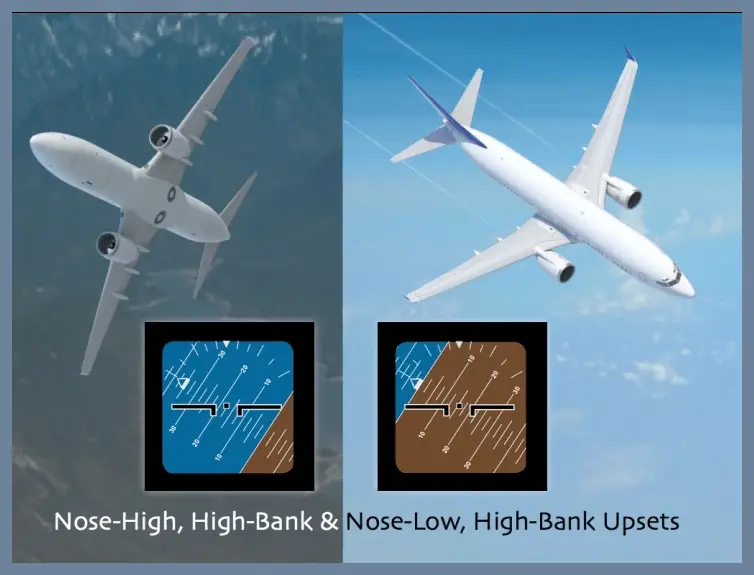
Nose High and Decreasing Airspeed
In aviation, a nose-high and decreasing airspeed unusual attitude refers to a scenario where the aircraft’s nose is pitched upward, causing the airspeed to drop. This situation can be dangerous because if the nose is too high and the airspeed falls too low, the aircraft may enter a stall, where the wings no longer generate sufficient lift to keep the plane flying. Here’s how pilots typically recover from this unusual attitude:
Recognition
- Visual cues: The horizon will be below the nose, and the aircraft’s pitch attitude will be unusually high.
- Instrument cues:
- The attitude indicator will show an excessive nose-up attitude.
- The airspeed indicator will show decreasing airspeed.
- The vertical speed indicator (VSI) may show a climb.
Recovery Procedure
- Reduce the pitch attitude: Push forward on the control yoke or stick to lower the nose. This action is crucial to stop the airspeed from decreasing further and avoid a stall.
- Apply power: If the power isn’t already at full throttle, increase it to maximum to help prevent further airspeed loss and to assist with recovery.
- Roll to level wings: Use aileron control to bring the wings to level flight if there is a bank angle. However, prioritize lowering the nose first to prevent a stall.
- Monitor airspeed: As the nose lowers and the aircraft accelerates, make sure the airspeed increases to a safe value.
- Stabilize the aircraft: Once the aircraft is level and the airspeed is increasing, reduce power as necessary and return to normal flight attitude.
Key Considerations
- Avoid pulling back too soon: The instinct might be to pull back on the yoke, but this can exacerbate the problem, especially if airspeed is already low.
- Avoid abrupt inputs: Smooth, coordinated control inputs are essential to avoid overstressing the aircraft.
- Situational awareness: Continuously scan the instruments and outside environment for clues on how the aircraft is behaving.
If you are interested you should read about How to Fly Solo for the First Time

Nose Low and Increasing Airspeed
In a nose-low and increasing airspeed unusual attitude, the aircraft’s nose is pitched downward, causing airspeed to rapidly increase. This situation can be dangerous because if the aircraft is allowed to continue descending at a high rate, it can lead to structural damage, excessive speed, or a dive from which recovery becomes more difficult.
Recognition
- Visual cues: The horizon is well above the nose of the aircraft, indicating a steep nose-down attitude.
- Instrument cues:
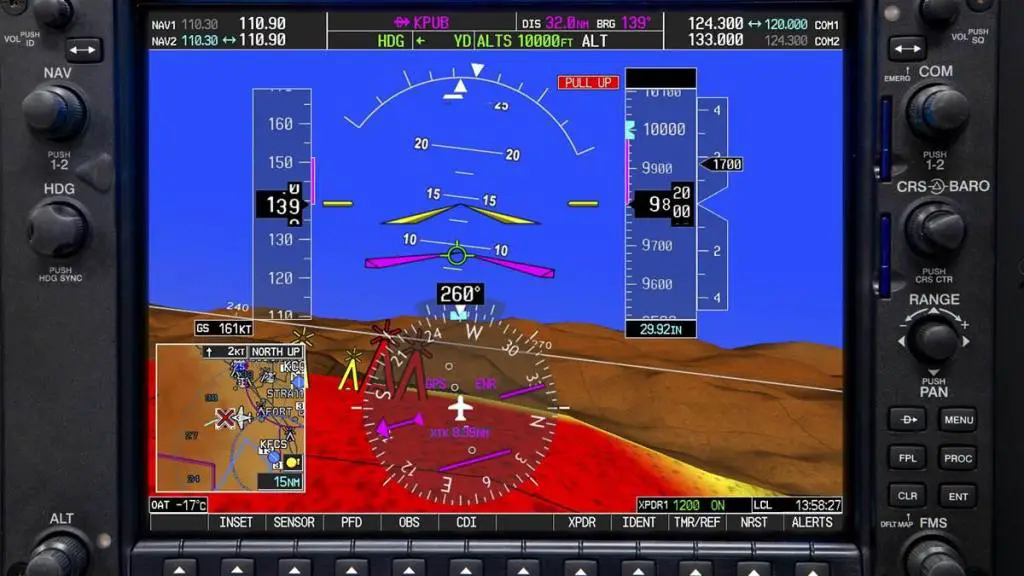
- The attitude indicator shows a steep nose-down pitch.
- The airspeed indicator shows rapidly increasing airspeed.
- The altimeter shows a rapid loss of altitude, and the VSI will indicate a descent.
- Engine sound may increase due to higher airspeed.
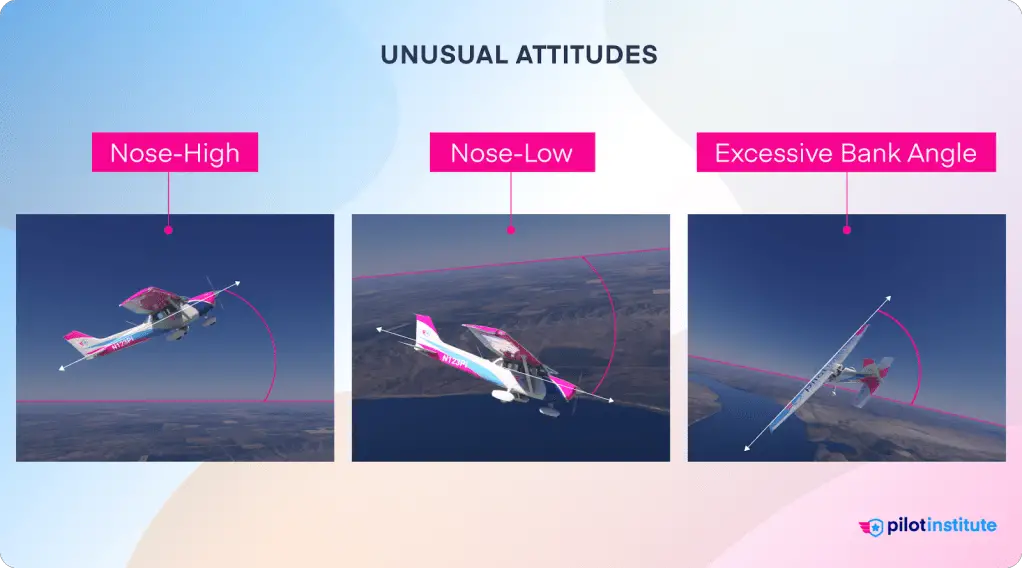
The Photo Credits: Pilot Institute
Recovery Procedure
- Reduce power: Throttle back to idle or as needed to prevent excessive airspeed, which helps avoid overstressing the aircraft.
- Roll wings level: If the aircraft is in a bank, use coordinated aileron and rudder inputs to level the wings. Rolling wings level is crucial before attempting to raise the nose, as this helps prevent overloading the aircraft during recovery.
- Gently raise the nose: After leveling the wings, pull back gently on the control yoke or stick to bring the nose up. The key is to do this gradually to avoid exceeding G-force limits or inducing a stall at the end of the recovery.
- Stabilize the airspeed and altitude: As the aircraft’s nose comes back to a level attitude, adjust the throttle back to a normal cruise setting and monitor your altitude and airspeed to return to stable flight.
Key Considerations
- Avoid over-stressing the aircraft: A rapid recovery with aggressive control inputs in a high-speed nose-low attitude could lead to structural damage.
- Prioritize wings level: In a nose-low situation, banking can worsen the descent. Leveling the wings helps control the descent and prepares the aircraft for recovery.
- Watch airspeed: Avoid allowing the airspeed to increase to the point where it exceeds the aircraft’s design limits (Vne—never exceed speed).
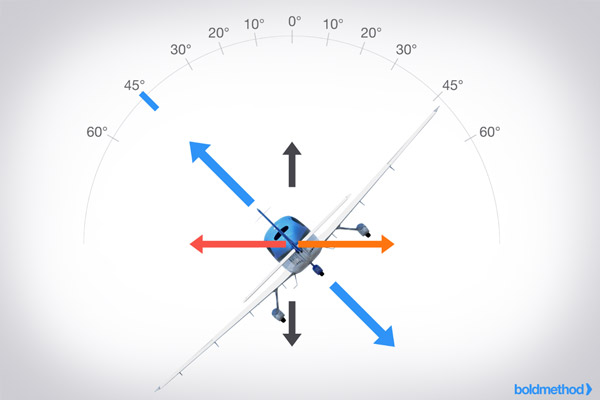
Photo Credits: BoldMethod
Excessive Bank Angle
An excessive bank angle unusual attitude occurs when the aircraft’s wings are tilted at an extreme angle, either due to an inadvertent input, disorientation, or other factors. A high bank angle, especially combined with low airspeed, can result in a dangerous situation such as a spiral dive, overstressing the airframe, or a loss of control.
Recognition
- Visual cues: The horizon may appear tilted sharply to one side, or it may even disappear entirely if the aircraft is banked beyond 90 degrees.
- Instrument cues:
- The attitude indicator shows a steep bank angle (beyond 45 degrees).
- The turn coordinator or slip/skid indicator shows a significant rate of turn.
- The airspeed may either increase rapidly (in a descending turn) or decrease (if combined with a nose-high attitude).
- The altimeter may indicate a rapid loss of altitude if the aircraft is descending in a turn.
Recovery Procedure
- Reduce power (if descending): If the aircraft is in a steep descent, reduce power to prevent excessive airspeed buildup. In extreme bank angles, the aircraft is often also nose-low, leading to rapid speed increases.
- Roll wings level: Priority should be given to leveling the wings. Use aileron input to gradually roll the wings back to a level attitude. Be careful not to overcorrect, as this can lead to the opposite bank.
- Neutralize yaw and pitch: Once the wings are level, coordinate rudder and elevator inputs to maintain the aircraft’s heading and pitch. Avoid pulling back aggressively on the yoke/stick during the recovery, as this could induce a stall, especially if airspeed is low.
- Adjust power as necessary: Once wings are level and the aircraft is in a stable attitude, adjust power to maintain a normal cruise or climb speed, depending on the situation.
Key Considerations
- Avoid abrupt control inputs: In an excessive bank angle situation, sudden or aggressive control movements can exacerbate the problem or lead to an overstressed airframe, especially at high speeds.
- Recognize spatial disorientation: Excessive bank angles can often be caused by spatial disorientation, particularly when flying in poor visibility. Relying on instruments is critical in such situations.
- Monitor airspeed and altitude: In a descending steep bank, airspeed can increase rapidly. In a nose-high steep bank, the aircraft may stall if the airspeed drops too low.
Example of Dangerous Situations
- Spiral dive: In an excessively banked descent, the aircraft may enter a spiral dive, where the bank angle increases, the descent steepens, and airspeed accelerates dangerously. Immediate recovery by rolling wings level and reducing power is essential.
- Increased G-load: At high bank angles, the G-load (gravitational force) on the aircraft increases exponentially, requiring greater lift and leading to higher stall speeds and potential structural damage.
FAQs
1. What are unusual attitudes in aviation?
Unusual attitudes occur when an aircraft is in a position not intended for normal flight, such as extreme pitch (nose-up or nose-down) or excessive bank angles (steep turns). These can happen due to spatial disorientation, turbulence, or pilot error.
2. What causes unusual attitudes?
- Spatial Disorientation: Losing track of the aircraft’s position relative to the horizon, especially in low visibility.
- Turbulence: Sudden, unpredictable air movement can upset the aircraft’s attitude.
- Pilot Error: Incorrect control inputs or distractions during flight.
- Mechanical Failures: Malfunctions can lead to an uncommanded attitude.
3. What are the key steps for recovering from an unusual attitude?
- Recognize the Situation: Use instruments to identify the problem.
- Confirm the Attitude: Focus on the attitude indicator (artificial horizon).
- Apply Recovery Procedures:
- For nose-up: Lower the nose, reduce power, and level the wings.
- For nose-down: Reduce power, level the wings, and raise the nose gently.
- Re-establish Normal Flight: Return to a stable altitude and heading.
4. How do you identify an unusual attitude?
Unusual attitudes can be identified by:
- Attitude Indicator: Confirms pitch and bank angles.
- Altimeter: Indicates abnormal altitude changes.
- Airspeed Indicator: Rapid increases or decreases suggest an issue.
- Turn Coordinator and Vertical Speed Indicator: Show erratic movement.
5. What role do flight instruments play in unusual attitude recovery?
Instruments are critical, especially in IMC (Instrument Meteorological Conditions):
- Attitude Indicator: Shows pitch and bank position.
- Airspeed Indicator: Alerts if the aircraft is approaching a stall or overspeed.
- Altimeter: Tracks altitude changes during recovery.
- Turn Coordinator: Ensures the aircraft is not in an unintended roll.
6. How do you recover from a nose-high unusual attitude?
- Lower the nose by pushing the yoke forward.
- Add power if airspeed is too low.
- Level the wings using ailerons.
- Re-establish a stable altitude and heading.
7. How do you recover from a nose-low unusual attitude?
- Reduce throttle to avoid overspeeding.
- Level the wings to stop any rolling motion.
- Gently raise the nose to avoid excessive G-forces.
8. Why is spatial disorientation a common cause of unusual attitudes?
Spatial disorientation occurs when the body’s sensory inputs conflict with instrument readings. For example, during IMC, the lack of visual cues can trick pilots into thinking the aircraft is level when it’s not.
9. How can pilots prevent unusual attitudes?
- Proper Training: Practice recovery techniques in simulators or with an instructor.
- Instrument Proficiency: Maintain skills to rely on instruments during IMC.
- Situational Awareness: Monitor instruments and avoid distractions.
- Avoidance Techniques: Fly around severe turbulence or poor weather.
10. What is the “Upset Recovery Training Program”?
The Upset Recovery Training Program teaches pilots how to prevent, recognize, and recover from unusual attitudes or aircraft upsets. It is often conducted in simulators or with aerobatic instructors.
11. How do autopilots handle unusual attitudes?
Modern autopilots are equipped with recovery modes that stabilize the aircraft automatically. However, pilots must know how to recover manually in case of autopilot failure.
12. What are common mistakes pilots make during recovery?
- Overcorrecting or using excessive control inputs.
- Ignoring instrument readings in favor of gut instincts.
- Forgetting to reduce power in a nose-low recovery, leading to overspeed.
- Delaying action due to indecision or confusion.
13. How do unusual attitudes differ between VFR and IFR pilots?
- VFR Pilots: Rely on visual cues to identify and recover, but may struggle in IMC.
- IFR Pilots: Use instruments exclusively, making them better equipped for recovery in poor visibility.
14. How do stall warnings relate to unusual attitude recovery?
Stalls can result from nose-high attitudes where airspeed decreases. Recovery involves reducing pitch and adding power to regain control before a full stall occurs.
15. Can turbulence cause unusual attitudes?
Yes, severe turbulence can disrupt the aircraft’s attitude, especially if the pilot is unprepared or overcorrects.
16. What training tools help pilots practice unusual attitude recovery?
- Simulators: Offer a safe environment for practicing scenarios.
- Aerobatic Training: Teaches recovery from extreme attitudes.
- Upset Recovery Courses: Provide hands-on experience and advanced techniques.
17. How do G-forces affect unusual attitude recovery?
Excessive G-forces can disorient the pilot or damage the aircraft if not managed correctly. Smooth and controlled recovery inputs are essential to avoid undue stress on the airframe.
18. What role does communication play during unusual attitude recovery?
If time permits, pilots should communicate with ATC, informing them of the situation. This allows ATC to clear airspace and provide assistance.
19. Can passengers sense unusual attitudes?
Passengers may feel sudden drops, turns, or weightlessness. Keeping them informed and calm can prevent panic.
20. Are there aircraft-specific factors in unusual attitude recovery?
Yes, recovery techniques may vary depending on the aircraft’s:
- Weight and balance.
- Control responsiveness.
- Engine performance and configuration.
21. How does fatigue impact unusual attitude recovery?
Fatigue impairs decision-making, reaction times, and instrument interpretation, making recovery more challenging.
22. Are there real-life examples of unusual attitude recovery?
Yes, there are many instances where skilled pilots have successfully recovered. For example, the Qantas Flight 72 incident involved a sudden pitch-down due to a malfunction, and the pilots managed to stabilize the aircraft, saving lives.
23. What are the dangers of failing to recover from unusual attitudes?
Failure to recover can lead to:
- Stalls or spins.
- Structural damage due to excessive speed or G-forces.
- Controlled flight into terrain (CFIT).
24. What are common signs of a successful recovery?
- Aircraft is in a level and stable flight.
- Instruments show normal readings.
- Pilot regains situational awareness and control.
 Aviator Tells
Leave a comment